

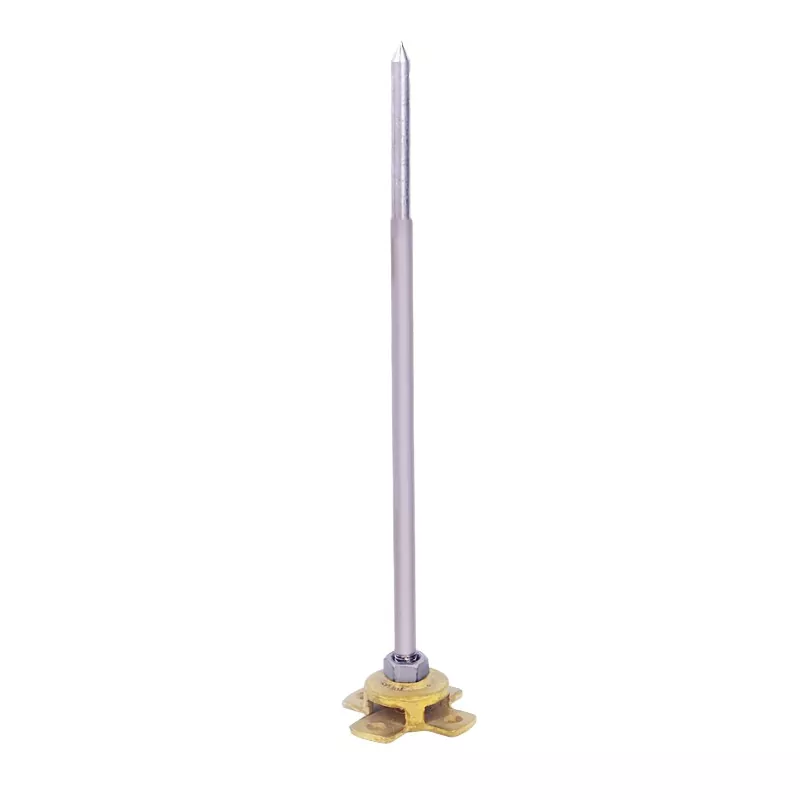
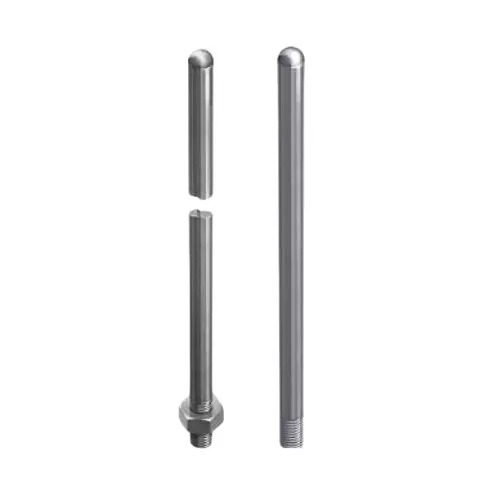
Aluminum Lightning Rod Needle Type
For temporary construction camps, residential PV systems, simple workshops, and lightweight rooftops, Saint Ni Lightning Protection provides an air-terminal solution focused on low weight, convenient handling, and efficient installation. Manufactured from solid aluminum alloy, the Aluminum Lightning Rod Needle Type reduces the manual handling burden during rooftop and high-altitude installation while supporting aluminum-compatible down-conductor systems.
Saint Ni Lightning Protection Aluminum Lightning Rod Needle Type are designed for lightweight lightning protection projects where easy handling, simple installation, and controlled procurement costs are important. Made from solid aluminum alloy with one-piece machining, the product combines low weight, good electrical conductivity, natural oxidation resistance, and reliable mechanical strength.
The lightweight construction is suitable for temporary buildings, small residential rooftops, distributed PV systems, and simple steel structures. With an integrated aluminum base and matching terminals, installation can be completed by bolting without hot work. For aluminum-to-copper connections, isolation washers and suitable conductive anti-corrosion compounds are recommended to reduce galvanic corrosion.
Product Features
Lightweight Construction
The solid aluminum alloy structure reduces the overall weight of the air terminal, making manual transportation and high-altitude installation easier. This is particularly useful for mountain PV projects, temporary construction camps, and rooftops where lifting equipment is unavailable or difficult to use.
Single-Tip Design
The single-tip configuration is suitable for localized lightning protection at building high points, transformer boxes, simple rooftops, and small outdoor equipment. Its streamlined tip helps concentrate the surrounding electric field and provides a defined interception point when the protection system is designed according to applicable lightning protection requirements.
Mechanical Installation
The base is secured with bolts rather than on-site welding. This reduces the need for welding equipment, hot-work permits, fire isolation measures, and additional construction preparation, making installation more convenient in temporary or controlled construction areas.
Surface Corrosion Protection
Aluminum naturally forms a dense aluminum oxide film when exposed to air. This passive layer provides basic surface protection in dry inland and mildly corrosive environments. Actual service life depends on the aluminum alloy grade, environmental conditions, connection design, installation quality, and maintenance practices.
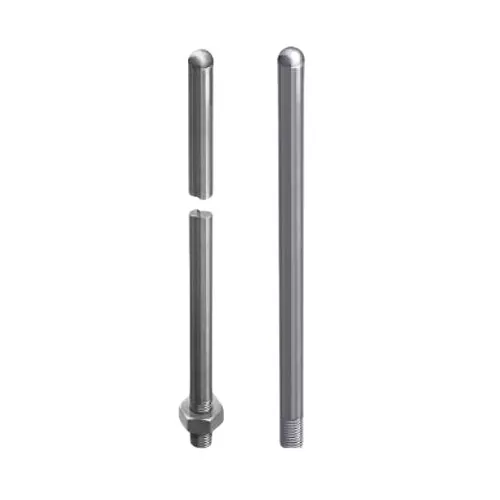
Product Parameters
|
Parameter |
Specification |
|
Product Type |
Aluminum Lightning Rod Needle Type |
|
Material |
Solid Aluminum Alloy |
|
Manufacturing |
One-Piece Machined |
|
Structure |
Single Needle |
|
Available Height |
600–2000 mm, customizable |
|
Rod Diameter |
Customizable |
|
Base Material |
Aluminum Alloy |
|
Terminal Material |
Aluminum Alloy |
|
Wind Resistance |
≥45 m/s |
|
Installation |
Bolted Connection |
|
Application |
Class II & Class III Civil Lightning Protection |
|
Down Conductor |
Aluminum or Compatible Conductor System |
|
Grounding System |
Grounding Rod + Grounding Grid |
|
Surface Protection |
Natural Aluminum Oxide Passivation |
|
Customization |
Height, Diameter and Mounting Dimensions |
The actual height, rod diameter, base dimensions, alloy grade, and connection configuration can be adjusted according to the lightning protection design, building height, installation structure, and applicable local standards. For engineering procurement, the air terminal should be evaluated as part of the complete air-terminal, down-conductor, and grounding system rather than selected only according to its physical height.
Product Testing
Material Inspection
Saint Ni Lightning Protection can provide material-related inspection documents according to batch and project requirements. Aluminum alloy grade, appearance, dimensions, and machining quality can be checked before shipment. Material certificates or third-party inspection documents can also be supplied when required by the project contract.
Dimensional Inspection
The overall length, rod diameter, base hole spacing, and terminal dimensions are inspected before delivery to ensure compatibility with mounting structures, down conductors, and other grounding components. This helps reduce secondary processing at the construction site.
Mechanical Testing
The Aluminum Lightning Rod Needle Type body and base structure are checked for mechanical strength and connection reliability. The specified wind resistance is ≥45 m/s. Actual installation suitability should also consider building height, mounting method, local design wind speed, snow load, and structural calculations.
Electrical Continuity Testing
Electrical continuity between the rod body, base, and terminal is checked as required. For aluminum-to-copper connections, appropriate isolation measures are used to reduce the possibility of galvanic corrosion. After the complete lightning protection system is installed, grounding resistance should be measured according to applicable local standards.
Environmental Testing
Salt spray and environmental resistance test documentation can be provided according to project requirements. For coastal, high-humidity, or high-salt environments, the alloy grade and surface treatment should be selected according to the actual corrosion level rather than relying only on the natural oxide film for long-term protection.
Installation
Roof Positioning
The installation location should be determined according to the lightning protection design. Typical locations include roof ridges, the highest points of buildings, transformer box tops, and areas above equipment requiring direct lightning protection.
Base Fixing
The base is positioned on a structurally suitable mounting surface and secured with expansion bolts or other appropriate fasteners. The installer should check the base alignment and bolt torque to prevent loosening caused by long-term vibration or wind loading.
Down-Conductor Connection
An aluminum down conductor can be connected directly to the compatible aluminum terminal. When a copper conductor is required, an appropriate bimetallic connection method, isolation washer, and anti-corrosion conductive compound should be used. The contact surfaces should be clean and securely compressed.
Grounding Connection
The down conductor should be routed along the building exterior using an appropriate path and connected to the grounding electrode and grounding grid. After installation, grounding resistance should be measured and documented according to the applicable lightning protection requirements.
Applications
Temporary Construction Camps
The Aluminum Lightning Rod Needle Type is suitable for mountain PV construction camps, temporary offices, prefabricated buildings, and temporary power distribution facilities. Its low weight helps reduce manual transportation and high-altitude installation requirements.
Residential PV Systems
It can be used for small residential buildings and rural rooftops as part of a complete lightning protection system. When paired with suitable aluminum down conductors and grounding components, it provides a lightweight option for residential PV projects.
Simple Workshops
The Aluminum Lightning Rod Needle Type can be applied to color-coated steel workshops, temporary warehouses, and small processing facilities. Bolted installation reduces the need for on-site welding and simplifies construction organization.
Small Outdoor Equipment
It can be used according to the lightning protection design for small distribution rooms, transformer boxes, communication auxiliary facilities, and other outdoor equipment requiring an independent air-terminal.
Project Case
Project: 100 MW PV Temporary Construction Camp Lightning Protection Project, Western Sichuan, China
The project included temporary buildings, PV substations, and exploration equipment in a dry mountainous area. Because materials had to be transported manually and hot work was prohibited near the temporary power distribution rooms, the design team selected lightweight aluminum lightning rods with bentonite resistance-reducing agents.
A 1.2 m rod was installed at the highest point of each temporary building and PV substation, using aluminum down conductors and aluminum grounding clamps. Copper-clad steel stranded wire and Φ16 hot-dip galvanized grounding rods formed the underground grounding grid. Aluminum-copper connections were fitted with isolation washers to reduce galvanic corrosion, while all connections were secured with torque wrenches without welding.
More than 430 units were installed. Manual transportation efficiency increased by 60%, while the main material cost was reduced by 41% compared with a brass solution. After two years of operation, inspections found no significant deformation or corrosion, and the temporary facilities remained free from lightning-related shutdowns. The system also supported dismantling and reuse after project completion.
Return & Exchange Policy
Receiving Inspection
Please check the product specifications, quantity, and appearance immediately after receiving the goods. If there is shipping damage, incorrect shipment, or missing items, photographic evidence should be provided within 24 hours. Saint Ni Lightning Protection will arrange free reshipment or a partial return/exchange according to the actual situation and cover the corresponding shipping costs.
Selection Errors
For returns or exchanges caused by incorrect product selection, engineering changes, or incorrect dimensions, only unused products with complete packaging can normally be accepted. Applicable return shipping and packaging costs may be deducted. Products that have been cut, drilled, installed, or otherwise modified during construction are not eligible for standard returns or exchanges.
Installation Damage
Damage caused by impact, improper installation, unsuitable environmental conditions, or other non-product-related causes is not covered by the standard return and exchange policy. Engineering quality issues can be reviewed based on product photographs, production batch information, and installation details.
FAQ
Q1: Is this product suitable for long-term outdoor installation?
It can be suitable for dry inland and relatively low-corrosion environments. For coastal, high-salt, high-humidity, or chemically corrosive locations, the aluminum alloy grade and surface treatment should be selected according to the actual environment and project design.
Q2: Can aluminum be connected directly to a copper down conductor?
Direct long-term bare contact is not recommended. Aluminum and copper are dissimilar metals and may experience galvanic corrosion in humid conditions. Suitable bimetallic connection components, isolation washers, and anti-corrosion conductive materials should be used according to the installation requirements.
Q3: Can the product still be used if the tip is scratched during transportation?
Minor surface scratches do not necessarily affect the lightning interception function. However, deep dents, cracks, or structural deformation should be inspected carefully. Products with significant structural damage should not be installed.
Q4: Can it replace an existing stainless steel lightning rod?
Replacement may be possible when the mounting dimensions and protection design are compatible. The existing base, hole spacing, conductor connection, and grounding system should be checked before replacement. Any aluminum-to-dissimilar-metal connection should also receive appropriate corrosion protection.
Q5: Can the product be reused after a temporary project is completed?
It may be reused if the rod body, tip, base, fasteners, and terminals remain structurally sound and free from significant corrosion or deformation. Before reuse, the product should be inspected and confirmed to meet the requirements of the new lightning protection design.
Quality & Supply
Saint Ni Lightning Protection manufactures aluminum lightning protection components using solid aluminum alloy and controlled machining processes. The company operates under GB/T19001-2016 / ISO9001:2015 quality management and GB/T24001-2016 / ISO14001:2015 environmental management systems.
Standard specifications are available for regular projects, with customized heights and dimensions supported for engineering applications. Saint Ni Lightning Protection can also provide product testing documents and samples for conductivity, corrosion resistance, and mechanical performance evaluation.
Send Inquiry
Contact Info
-
Address
Woxi Avenue, Chengtan Street, Xinchang County, Shaoxing City, Zhejiang Province, China
-
Tel
-
Email
Get a Tailored Quote for Your Lightning Protection Project
Whether you need standard grounding rods, custom-engineered materials, or a complete system solution for a large-scale infrastructure project, Saint Ni is here to help. As a direct manufacturer with our own factory in China, we provide competitive pricing, fast response, and expert technical support.
Complete the form below and our engineering team will respond within 24 hours with a customized recommendation — including product specifications, certifications, and shipping options tailored to your region.
Related Products

News Recommendations