

Brass Lightning Rod Needle Type
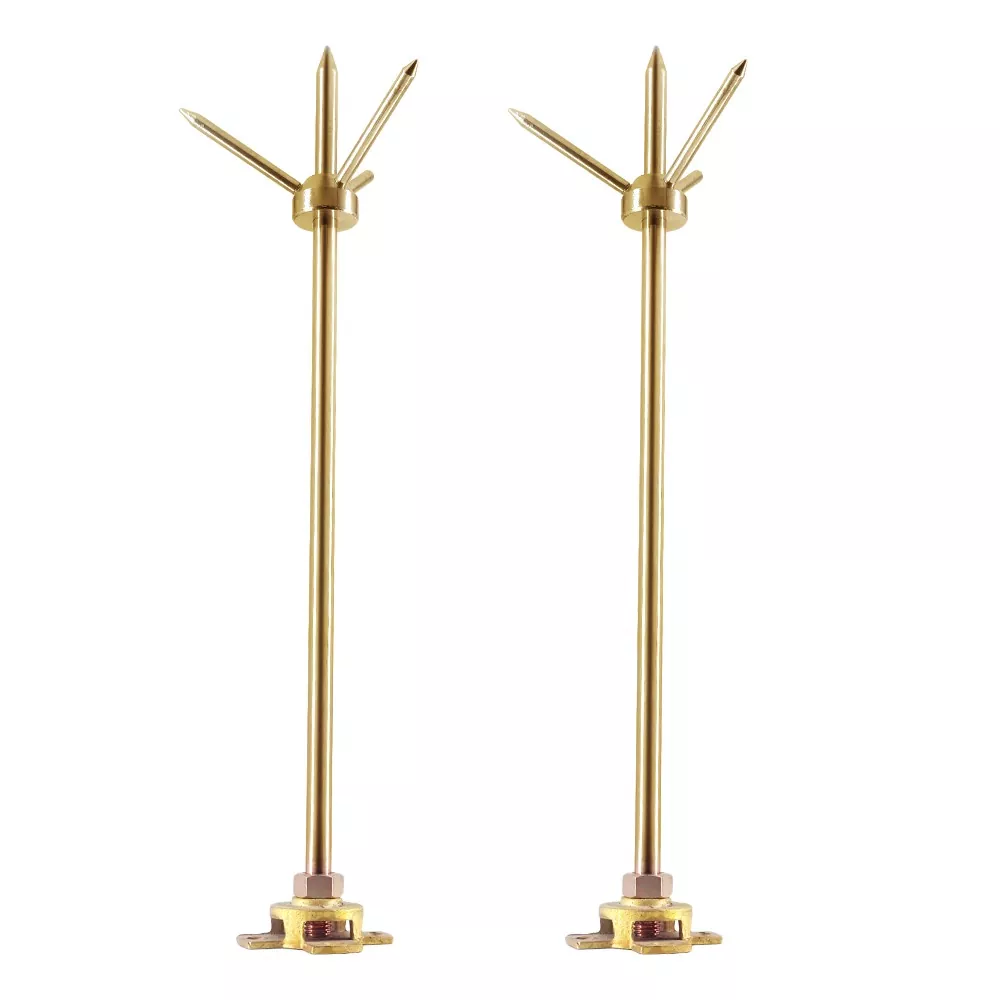
Saint Ni Lightning Protection Brass Lightning Rod Needle Type is a solid-machined brass air terminal designed for residential buildings, small industrial facilities, and photovoltaic installations. Made from corrosion-resistant copper-zinc alloy, it combines reliable electrical conductivity with mechanical strength and lower procurement cost than pure copper alternatives.
Saint Ni Lightning Protection manufactures brass lightning protection components for residential, photovoltaic, commercial, and small industrial projects. This Brass Lightning Rod Needle Type is machined from solid brass and designed for reliable lightning interception and current conduction. Its single-point structure provides a practical solution for projects where lightning protection performance, mechanical strength, installation space, and procurement cost all need to be considered.
The solid brass construction combines electrical conductivity, structural strength, and atmospheric corrosion resistance. With a matching brass base and terminal, it can be connected with copper down conductors to form a complete lightning interception and grounding system.
Material and Construction
The Brass Lightning Rod Needle Type is manufactured from solid copper-zinc alloy through precision machining without welded joints. The streamlined needle tip creates a concentrated electric field during thunderstorms, while the reinforced rod body provides resistance to bending caused by outdoor wind and snow loads.
Brass naturally develops a protective surface layer during oxidation, providing resistance to atmospheric corrosion in humid and mildly saline environments. For projects with additional appearance or corrosion-control requirements, Saint Ni Lightning Protection can provide polishing and other surface treatments according to project conditions.
Solid Brass Body
The solid structure reduces potential weak points associated with welded or assembled sections. Precision machining also helps maintain consistent dimensions between production batches, which is important when hundreds of lightning protection points need to be installed across similar buildings or photovoltaic equipment.
Connection Design
The Brass Lightning Rod Needle Type can be supplied with a matching brass base and terminal. Direct connection with copper down conductors helps simplify the installation structure and reduces the need for additional transition components. The final connection should be designed and tightened according to the applicable lightning protection requirements.

Material Comparison
Different lightning rod materials provide different combinations of conductivity, strength, corrosion resistance, and cost. Brass is positioned as a practical option for projects requiring a balance between electrical performance and procurement budget.
|
Material |
Electrical Conductivity |
Corrosion Resistance |
Mechanical Strength |
Cost Level |
Typical Application |
|
Pure Copper |
Approx. 100% IACS |
Excellent |
Medium |
High |
High-end and highly corrosive environments |
|
Brass |
Approx. 26–30% IACS |
Good |
High |
Medium |
Residential, PV and small industrial projects |
|
Aluminum |
Approx. 61% IACS |
Moderate |
Medium |
Low |
Lightweight lightning protection systems |
|
Stainless Steel |
Approx. 2–3% IACS |
Excellent |
High |
Medium |
Structures requiring high mechanical strength |
Brass has lower electrical conductivity than pure copper but provides a useful combination of mechanical strength, corrosion resistance, machinability, and cost control. Compared with pure copper models, it can reduce procurement costs by more than 35% according to the supplied project information, making it suitable for projects requiring large quantities of single-point air terminals.
Technical Parameters
The product is available in several standard configurations for residential buildings, photovoltaic equipment, commercial structures, and small industrial facilities.
|
Item |
Specification |
|
Product Type |
Needle Type Lightning Rod |
|
Material |
Brass Copper-Zinc Alloy |
|
Electrical Conductivity |
Approx. 26–30% IACS |
|
Standard Length |
0.6–2.0 m |
|
Rod Diameter |
12–20 mm |
|
Wind Resistance |
≥40 m/s |
|
Surface Finish |
Natural Brass / Polished |
|
Base Material |
Brass |
|
Terminal Material |
Brass |
|
Connection |
Bolt Connection |
|
Customization |
Length, Diameter, Base and Surface Finish |
|
Application |
Class II and Class III Lightning Protection Systems |
For projects requiring different dimensions, Saint Ni Lightning Protection can customize the length, rod diameter, base structure, and connection configuration according to engineering drawings and installation requirements.
Installation Conditions
Rooftop Positioning
The suitable installation point is normally selected at the roof ridge, highest roof position, tower top, or the designated lightning interception location determined by the protection design. The mounting position should provide sufficient structural support and should not interfere with other rooftop equipment.
Down Conductor Connection
The brass base or terminal is connected to the copper down conductor using an appropriate mechanical connection. The contact surfaces should be clean and firmly tightened, while anti-corrosion conductive compound may be used where required by the project specification.
Grounding System
The air terminal must form part of a complete system consisting of the lightning interception point, down conductor, and grounding network. Grounding electrode type, conductor size, grounding resistance, and installation depth should be determined according to local standards and engineering calculations rather than relying on the lightning rod alone.
Product Testing
Dimensional Inspection
Saint Ni Lightning Protection checks rod length, diameter, connection dimensions, base dimensions, and overall appearance before shipment. Dimensional control helps ensure that the products match customer drawings and mounting structures.
Conductivity Testing
Electrical conductivity can be evaluated according to the material and project requirements. The brass material used for this Brass Lightning Rod Needle Type provides approximately 26–30% IACS conductivity, while samples can be supplied for independent customer verification when required.
Corrosion Testing
Salt spray and corrosion-resistance testing can be arranged for project-specific requirements, particularly when products are intended for humid, coastal, or mildly saline environments. Test reports can be provided according to the agreed inspection requirements.
Mechanical Testing
Mechanical inspection focuses on the structural condition of the solid rod and mounting components. Wind resistance is designed around a reference value of ≥40 m/s for the standard structure. For higher wind-load requirements, Saint Ni Lightning Protection can evaluate reinforced configurations according to the installation environment.
Application Areas
The Brass Lightning Rod Needle Type is suitable for compact single-point lightning interception applications, including residential buildings, rural housing, small factories, warehouses, rooftop photovoltaic equipment, PV transformer substations, communication facilities, and small commercial structures.
The single-point configuration is particularly practical for projects with many individual equipment units. Its lower material cost compared with pure copper models can help control the total procurement budget while maintaining the required electrical and mechanical characteristics.
Thailand PV Project
Project Background
A 32 MW distributed photovoltaic project in Thailand required individual lightning protection for numerous outdoor PV transformer substations. The site was located in an inland clay area with only localized mild saline-alkaline conditions, making a compact and economical single-point lightning protection solution appropriate.
Project Solution
Each PV substation was equipped with a 1 m brass lightning rod. A 25 mm² tinned yellow-green insulated copper stranded wire was used as the down conductor. The underground grounding system consisted of copper-clad steel horizontal stranded wire and Φ17.2 mm threadless copper-clad steel grounding rods.
The flange bases were secured directly to the steel structures on top of the substations using expansion bolts. Copper lugs were used to connect the down conductors to the bases, while the grounding electrodes were connected using exothermic welding. The site grounding resistance was retested annually using the four-pole method, with Chinese and English salt spray test reports provided for local power authority acceptance.
Application Results
After three years of operation, the brass lightning rods showed no significant corrosion, and no lightning-related inverter breakdown was reported during the thunderstorm seasons. Direct bolted installation also shortened the installation time for hundreds of substations.
The project reported a 63% reduction in lifecycle maintenance costs. The lower procurement cost of the single-point design also helped control the total cost of large-volume PV substation protection.
Quality and Certifications
Quality Management
Saint Ni Lightning Protection operates under the GB/T19001-2016 / ISO9001:2015 quality management system. Production control covers material inspection, machining, dimensional inspection, surface treatment, assembly, and final quality inspection.
Environmental Management
Saint Ni Lightning Protection also operates under the GB/T24001-2016 / ISO14001:2015 environmental management system, supporting controlled manufacturing and environmental management throughout the production process.
FAQ
Is brass suitable for outdoor lightning protection?
Brass provides good atmospheric corrosion resistance and is suitable for many residential, photovoltaic, commercial, and inland outdoor applications. For highly corrosive coastal or chemical environments, additional corrosion protection and material evaluation should be considered.
What is the electrical conductivity of brass?
The supplied brass material has an electrical conductivity of approximately 26–30% IACS. Although this is lower than pure copper, brass offers a practical balance between conductivity, mechanical strength, corrosion resistance, and procurement cost.
What wind speed can the product withstand?
The standard structure is designed for a reference wind resistance of ≥40 m/s. For coastal areas, typhoon-prone regions, or installations with higher structural loads, reinforced mounting structures can be evaluated according to the project requirements.
What sizes are available?
Standard lengths range from 0.6 m to 2.0 m, with rod diameters from 12 mm to 20 mm. Customized dimensions and base configurations are available according to engineering drawings.
Does brass rust?
Brass does not produce iron-type rust. Its surface can gradually darken or develop a natural patina through oxidation. Mild surface discoloration does not necessarily indicate structural failure or loss of electrical function.
Can samples be provided?
Yes. Saint Ni Lightning Protection can provide samples for customer evaluation and independent testing, including dimensional, conductivity, corrosion-resistance, and mechanical-performance testing.
Hot Tags: Brass Lightning Rod Needle Type, Brass Air Terminal, Lightning Rod Needle
Send Inquiry
Contact Info
-
Address
Woxi Avenue, Chengtan Street, Xinchang County, Shaoxing City, Zhejiang Province, China
-
Tel
-
E-mail
Get a Tailored Quote for Your Lightning Protection Project
Whether you need standard grounding rods, custom-engineered materials, or a complete system solution for a large-scale infrastructure project, Saint Ni is here to help. As a direct manufacturer with our own factory in China, we provide competitive pricing, fast response, and expert technical support.
Complete the form below and our engineering team will respond within 24 hours with a customized recommendation — including product specifications, certifications, and shipping options tailored to your region.