

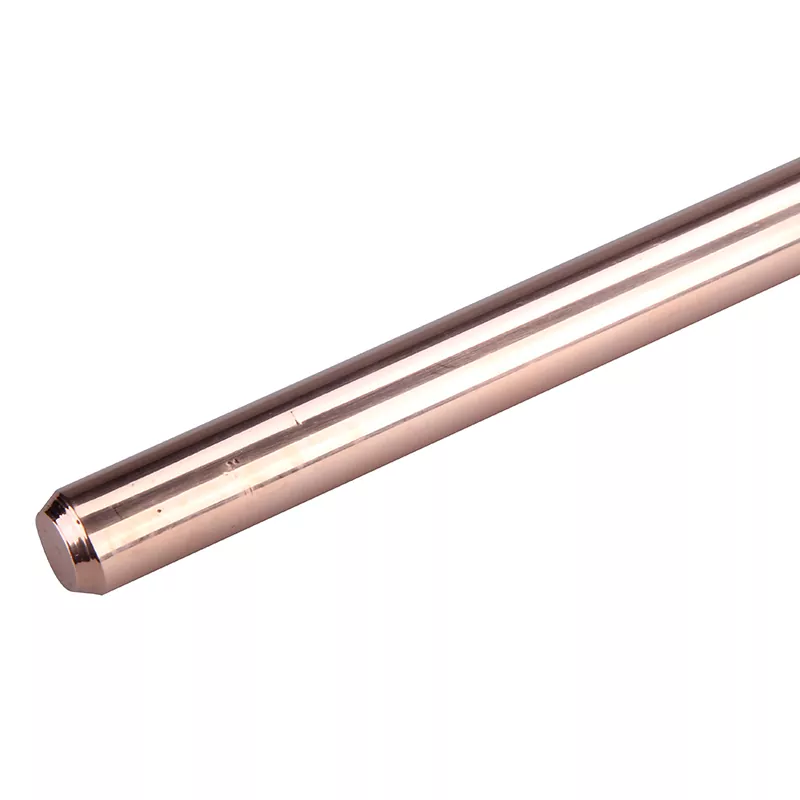


Nano Carbon Grounding Rod
Saint Ni Lightning Protection Nano Carbon Grounding Rod combines a galvanized steel core with a durable nano-carbon conductive anti-corrosion coating for vertical grounding in saline, acidic, alkaline, and chemically contaminated soils. It provides high mechanical strength, stable current dissipation, and improved corrosion protection for photovoltaic, wind power, energy storage, substations, chemical plants, oil fields, and mining projects.
Saint Ni Lightning Protection Nano Carbon Grounding Rod is designed for vertical grounding applications in corrosive soils where conventional galvanized grounding electrodes may experience accelerated corrosion. It combines a galvanized carbon steel core with a high-temperature formed nano-carbon conductive anti-corrosion coating. The steel core provides mechanical strength and the main current-dissipation path, while the outer coating helps isolate the electrode from moisture, salts, acidic or alkaline soil, and other corrosive media.
This structure allows the grounding electrode to be directly driven into the soil and used in photovoltaic power plants, wind power projects, chemical facilities, oil fields, mining areas, and energy storage systems. Saint Ni Lightning Protection supports sample orders, customized specifications, and bulk supply for overseas EPC contractors, grounding installers, and distributors.
Construction and Material Design
Galvanized Steel Core
The solid galvanized steel core provides the mechanical strength required for direct hammer-driven installation. Its zinc layer provides an initial corrosion protection barrier, while the steel body carries fault currents and lightning currents during grounding operation.
Nano-Carbon Protective Layer
The outer nano-carbon coating is formed through a high-temperature process to provide a continuous conductive and anti-corrosion surface. When properly handled and backfilled, the coating helps reduce direct exposure of the steel core to chloride ions, salts, moisture, and acidic or alkaline soil.
Connection Options
The product can be supplied in threadless versions for direct driving or threaded versions for extension in deeper grounding installations. Connection with grounding conductors can be completed by exothermic welding or suitable grounding clamps according to the project design.
Key Performance Features
Corrosion Protection
The dual protection structure of galvanized steel and nano-carbon coating is intended for grounding systems exposed to saline, acidic, alkaline, and chemically contaminated soils. It helps reduce corrosion-related deterioration and supports stable grounding performance over extended underground service.
Mechanical Strength
The steel core provides the rigidity required during transportation, handling, and direct installation. Threaded models can be connected with couplers where greater grounding depth is required.
Grounding Stability
The grounding electrode is designed to provide a reliable current-dissipation path for power-frequency fault currents and lightning protection systems. Proper electrode spacing, soil treatment, connection quality, and grounding-grid design remain important factors in achieving the required grounding resistance.


Project Case
173 MW Coastal Solar Power Plant in the Philippines
The project is located in Calatrava, Negros Province, Philippines, approximately 15 km from the coastline. The 173 MW photovoltaic power plant covers about 139 hectares and operates in a tropical environment characterized by high humidity, seasonal typhoons, salt exposure, and acidic soil containing chloride and sulfate ions.
The grounding system used 40×4 mm nano-carbon anti-corrosion flat steel as the horizontal grounding conductor, forming a closed grounding grid around the PV arrays. Nano carbon grounding rods measuring 2.4 m in length were installed at 5 m intervals. In rock-layer areas, threaded versions with brass coupling sleeves were used to extend the grounding depth to approximately 4 m.
The flat steel and Nano Carbon Grounding Rods were connected by three-sided exothermic welding. At welding locations, the coating was removed to expose the steel core before welding, after which the joints were cleaned and protected with conductive anti-corrosion asphalt paste. Grounding trenches were backfilled with screened fine soil to reduce the risk of mechanical damage to the protective coating.
After 21 months of operation, third-party inspections reported that sampled grounding-grid components showed no visible blistering, peeling, or cracking of the nano-carbon coating, while the galvanized steel cores showed no visible pitting or rust. Seasonal grounding-resistance measurements remained below the applicable project requirements. According to the project data, the grounding system also reduced primary material costs by approximately 33.5% compared with a copper-clad steel solution.
Typical Applications
Renewable Energy Projects
The product can be used for vertical grounding in photovoltaic power plants, wind farms, energy storage stations, and other renewable-energy facilities, particularly where the soil contains high levels of salt or moisture.
Industrial and Infrastructure Sites
It is suitable for grounding systems in chemical plants, oil fields, mining areas, substations, communication facilities, and other locations where underground grounding electrodes are exposed to corrosive soil conditions.
Corrosive Soil Areas
The combination of a galvanized steel core and nano-carbon protective coating is intended for saline-alkali soil, coastal areas, acidic soil, and chemically contaminated ground where conventional grounding electrodes may require more frequent inspection or replacement.
Installation Requirements
Direct Driving
For threadless models, position the electrode vertically with the pointed end facing downward and use suitable driving equipment to install it into the prepared grounding location. Avoid excessive impact that could damage the protective coating.
Extended Installation
Where greater grounding depth is required, threaded models can be connected using compatible couplers. The connection should be tightened securely and checked before the electrode is driven further into the ground.
Grounding Connection
When connecting the electrode to horizontal grounding conductors, use the specified exothermic welding or grounding-clamp method. If welding requires removal of the coating, the exposed area should be properly treated and protected after the connection is completed.
Backfilling and Testing
Use screened fine soil for backfilling where possible and avoid sharp stones that may damage the coating. After installation, test the grounding resistance according to the project specification and retain the inspection records for future maintenance.
FAQ
Can it be used in coastal or saline soil?
Yes. The product is specifically designed for grounding applications where soil corrosion is a major consideration, including coastal, saline-alkali, and chemically contaminated environments. Actual service life depends on soil chemistry, installation quality, and operating conditions.
Can the rod be extended for deeper installation?
Yes. Threaded models can be extended using compatible couplers where the project requires a deeper grounding electrode.
Can it withstand direct hammer installation?
The galvanized steel core provides the mechanical strength required for direct driving. However, appropriate driving equipment and installation procedures should be used to prevent excessive impact damage to the outer coating.
Will grounding resistance remain stable after long-term burial?
A properly installed grounding system can maintain stable performance, but grounding resistance is affected by soil resistivity, moisture, electrode depth, spacing, connections, and seasonal conditions. Regular testing is recommended for critical installations.
How should damaged coating areas be treated?
If the coating is damaged during transportation or installation, the affected area should be cleaned and repaired using a compatible anti-corrosion material before final backfilling. Severe coating damage should be inspected before the electrode is placed into service.
Manufacturing & Quality Control
Saint Ni Lightning Protection manufactures nano-carbon grounding electrodes using controlled production processes for the steel core, galvanized layer, and outer protective coating. Product quality can be evaluated through electrical conductivity, coating adhesion, corrosion resistance, and mechanical performance testing according to project requirements.
Saint Ni Lightning Protection operates under a GB/T 19001-2016 / ISO 9001:2015 Quality Management System and a GB/T 24001-2016 / ISO 14001:2015 Environmental Management System. Different diameters, lengths, connection configurations, and packaging options can be supplied for project-specific requirements.
For overseas EPC contractors, lightning protection contractors, and distributors, Saint Ni Lightning Protection supports sample testing and bulk procurement. Nano Carbon Grounding Rods can also be supplied together with grounding conductors, resistance-reducing agents, exothermic welding materials, and grounding connectors for complete grounding-system procurement.
Hot Tags: Nano Carbon Grounding Rod Manufacturer, Nano Carbon Grounding Rod Supplier, Carbon Grounding Rod Wholesale
Send Inquiry
Contact Info
-
Address
Woxi Avenue, Chengtan Street, Xinchang County, Shaoxing City, Zhejiang Province, China
-
Tel
-
E-mail
Get a Tailored Quote for Your Lightning Protection Project
Whether you need standard grounding rods, custom-engineered materials, or a complete system solution for a large-scale infrastructure project, Saint Ni is here to help. As a direct manufacturer with our own factory in China, we provide competitive pricing, fast response, and expert technical support.
Complete the form below and our engineering team will respond within 24 hours with a customized recommendation — including product specifications, certifications, and shipping options tailored to your region.


