

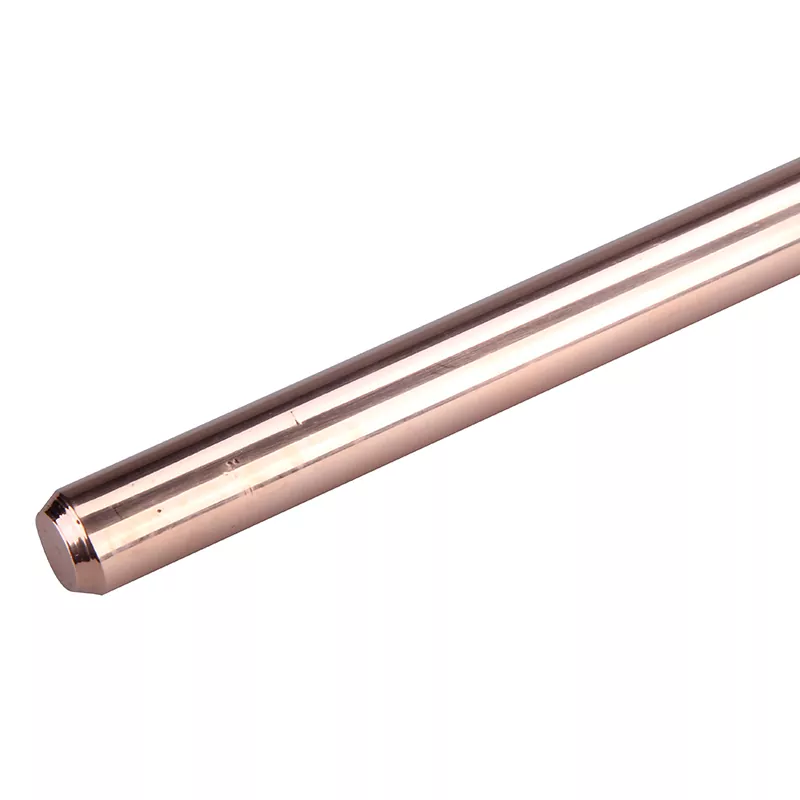


Stainless Steel Grounding Rod No Thread Type
Saint Ni Lightning Protection develops and manufactures stainless steel grounding components for construction, industrial facilities, renewable energy projects, coastal infrastructure, and other applications where long-term grounding reliability is important. The Stainless Steel Grounding Rod No Thread Type is designed around a simple installation principle: a solid stainless steel rod with a smooth shaft, a flat striking end, and no exposed threaded connection along the rod body.
Instead of focusing only on the initial purchase price, Saint Ni Lightning Protection considers the complete service cycle of a grounding electrode, including material selection, transportation, installation, corrosion exposure, connection stability, and future maintenance. The Stainless Steel Grounding Rod No Thread Type is available in 201, 304, and 316L stainless steel grades so buyers can select a suitable material according to soil conditions, chloride exposure, project location, and expected service requirements.
Saint Ni Lightning Protection operates its own manufacturing facility and controls product development, material processing, forming, inspection, and delivery management. The company has obtained GB/T19001-2016 / ISO9001:2015 Quality Management System Certification and GB/T24001-2016 / ISO14001:2015 Environmental Management System Certification, providing international buyers with a more traceable and standardized supply source.
Designed Around the Real Requirements of Grounding Projects
For grounding contractors and EPC buyers, the performance of an electrode is not determined by material composition alone. Installation conditions, connection methods, soil chemistry, transportation, and maintenance requirements can all affect the final performance of a grounding system. Saint Ni Lightning Protection therefore uses a smooth solid-bar construction to reduce unnecessary structural features and provide a practical electrode solution for projects where single-point or shallow vertical grounding is required.
The smooth shaft contains no exposed threads or connection grooves. This structure reduces areas where soil, moisture, mud, and salt can remain trapped after installation. The solid stainless steel construction also avoids the coating separation problems associated with some surface-treated or composite grounding products, making the electrode particularly suitable for projects where corrosion resistance is an important procurement consideration.
Material Selection Based on Site Conditions
201 Stainless Steel for Cost-Conscious General Applications
201 stainless steel can be considered for applications where the surrounding environment has relatively moderate corrosion conditions and the project places greater emphasis on material economy. It can be used for selected indoor, sheltered, or general grounding applications after the project engineer confirms that the environmental conditions are appropriate for this grade.
304 Stainless Steel for General Industrial and Inland Sites
304 stainless steel provides a practical balance between corrosion resistance and material cost. It is suitable for many inland factories, warehouses, commercial facilities, photovoltaic installations, and areas with mild saline or alkaline soil conditions. For buyers who need a stainless steel electrode without the higher material cost associated with 316L, 304 is often a practical starting point for project evaluation.
316L Stainless Steel for High-Chloride and Severe Corrosion Conditions
316L stainless steel contains molybdenum and offers enhanced resistance to chloride-containing environments compared with standard 304 stainless steel. It is therefore more appropriate for coastal infrastructure, marine-adjacent facilities, salt-fog environments, chemical plants, electroplating facilities, and other projects where the surrounding soil or atmosphere presents a higher corrosion challenge.


Construction Features That Simplify Field Installation
Solid Shaft With a Flat Striking End
The Stainless Steel Grounding Rod No Thread Type is manufactured as a solid stainless steel shaft with a flat, reinforced striking end. During installation, the upper end can withstand the impact generated by suitable driving equipment, while the smooth body avoids the deformation problems that may occur around exposed threads during transportation or installation.
No Threaded Sleeve Required for a Single Rod Installation
For applications where one grounding electrode is sufficient, the threadless structure removes the need for threaded extension sleeves between rod sections. The electrode can be positioned at the required location and driven into the prepared ground before the grounding conductor is connected using an appropriate approved connection method.
Reduced Accessories for Easier Project Management
A simpler electrode structure can also reduce the number of small components that contractors need to purchase, transport, store, and manage at the construction site. This is particularly useful for projects with many distributed grounding points, remote photovoltaic sites, coastal monitoring equipment, warehouses, and small industrial facilities.
Why the Smooth Structure Matters After Installation
A grounding electrode remains underground for a long period, so its performance depends not only on the installation day but also on its interaction with the surrounding soil over time. Threaded structures contain grooves and connection areas that may collect soil or moisture. Saint Ni Lightning Protection's smooth-bar design minimizes these geometric areas and provides a continuous surface that is easier to inspect before installation.
The natural passive film formed on stainless steel provides an additional layer of corrosion resistance. When the selected stainless steel grade is properly matched to the installation environment, the electrode can maintain its physical integrity over an extended underground service period. Actual service life remains dependent on soil chemistry, chloride concentration, moisture, stray current, installation quality, and other site-specific conditions.
Application-Oriented Selection for Different Projects
Coastal Ports and Marine Infrastructure
Coastal grounding systems are exposed to salt-laden air, high humidity, and potentially chloride-rich soil. For these locations, 316L stainless steel is generally more suitable when the project requires enhanced resistance to marine corrosion. The smooth rod construction also reduces areas where salt and contaminated soil can accumulate around the electrode surface.
Chemical, Electroplating, Pharmaceutical and Wastewater Facilities
Industrial sites may contain acidic, alkaline, or chemically active substances in the surrounding soil. Grounding electrodes used in these locations should therefore be selected according to the actual corrosion characteristics of the site. Saint Ni Lightning Protection can supply 304 and 316L options for engineering projects that require a stainless steel grounding solution matched to their environmental conditions.
Distributed Solar and Remote Energy Projects
Grounding points at distributed photovoltaic sites are often spread across large outdoor areas, while some projects are located in gravelly, mountainous, or remote terrain. The smooth single-rod construction simplifies transportation and field handling, while the solid stainless steel body provides the mechanical strength required for suitable driving operations.
Factories, Warehouses and Commercial Equipment Areas
For inland factories, warehouses, equipment rooms, and other general industrial sites, 304 stainless steel can provide a practical combination of corrosion resistance, mechanical durability, and purchasing economy when site conditions are compatible with the material grade. The electrode can be integrated into equipment grounding, lightning protection, static discharge, and other grounding arrangements according to the project design.
Engineering Case: Malaysia East Coast Coastal Industrial Park
Project Background
The East Coast Malaysia Coastal Industrial Park is exposed to year-round sea breezes carrying mild salt fog. The site's commercial spaces, small-scale processing facilities, and distributed residential PV systems share a single public grounding grid that complies with IEC international grounding standards. The local EPC contractor selected a threadless 316 stainless steel grounding solution to address the site's coastal exposure and long-term corrosion requirements. The selected rods had a design service life of ≥28 years, while the park's overall grounding resistance target was ≤4Ω.
Project Solution
Φ16mm × 2.0m threadless 316 stainless steel grounding rods were uniformly adopted throughout the site. The smooth, one-piece rod body was driven directly into the ground without threaded joints. During foundation pit backfilling, bentonite resistance-reducing material was applied around the rod body to improve grounding performance in high-resistance, salt-fog-prone soil.
The grounding system was complemented by stainless steel flat bars and stainless steel grounding clamps connected with bolts. Using compatible stainless steel components helped reduce the risk of galvanic corrosion between dissimilar metals. In the site's simplified explosion-proof areas, the installation arrangement avoided open-flame work during mechanical assembly. Grounding resistance was retested quarterly using the four-pole method, with English-language third-party test reports archived for project records.
Application Results
The project adopted a threadless, one-piece 316 stainless steel grounding structure to address salt accumulation and potential pitting corrosion around the grooves of conventional threaded grounding rods. After completion, the park's measured grounding resistance remained within a range of 2.6–3.7 Ω. After three years of operation, random excavation inspections found no visible rust or significant performance degradation on the inspected grounding rods.
Equipment problems associated with static electricity and induced lightning events were significantly reduced during the project operating period. The primary material cost was reported to be 42% lower than the pure copper solution considered for comparison, while the stainless steel construction also reduced concerns related to material theft. The complete English-language salt spray and material inspection documentation passed the Malaysian Energy Agency's acceptance inspection, providing a practical reference for corrosion-resistant grounding projects in coastal Southeast Asian industrial parks.
Quality Control From Material to Finished Rod
Saint Ni Lightning Protection applies standardized quality management throughout the manufacturing process. Stainless steel raw materials are selected according to the specified grade, while production processes are controlled to maintain consistent dimensions and surface quality. Finished grounding rods are inspected before shipment to reduce dimensional deviations and manufacturing defects that could affect transportation, installation, or project acceptance.
The company's GB/T19001-2016 / ISO9001:2015 Quality Management System Certification demonstrates its structured approach to quality management, while the GB/T24001-2016 / ISO14001:2015 Environmental Management System Certification supports its environmental management practices during manufacturing.
Product Configuration and Custom Manufacturing
Saint Ni Lightning Protection can supply different stainless steel grades, diameters, lengths, and surface configurations according to project requirements. Common project lengths can be selected according to the grounding design, soil conditions, installation depth, and transportation requirements. For engineering orders requiring non-standard dimensions, Saint Ni Lightning Protection can evaluate customized specifications based on drawings or technical requirements.
For large EPC projects, distributors, grounding contractors, and electrical material importers, customized packaging and batch production arrangements can also be discussed. This allows customers to align product dimensions and packaging with their procurement systems and project schedules.
Installation and Connection Considerations
Before installation, the project team should confirm the required grounding resistance, electrode length, soil characteristics, grounding layout, and applicable local electrical or lightning protection requirements. The rod should be driven using equipment suitable for the selected diameter and ground conditions, while excessive impact should be avoided if it may deform the electrode.
After the electrode reaches the required position, the grounding conductor can be connected using an appropriate approved connection method. Where exothermic welding is specified, the welding powder, mold, conductor material, and welding procedure should be selected according to the applicable engineering requirements. The final grounding resistance should be tested after installation and recorded as part of the project commissioning documentation.
Technical Information
| Parameter | Specification |
|---|---|
| Product Type | Threadless Stainless Steel Grounding Rod |
| Material Options | 201 / 304 / 316L Stainless Steel |
| Construction | Solid stainless steel, smooth shaft, no exposed threads |
| Rod Surface | Smooth and flat, no electroplated coating or composite cladding |
| End Design | Flat solid striking end |
| Common Length Range | 1.2 m–2.5 m; customized dimensions available |
| Typical Application | Grounding, lightning protection, static discharge and equipment grounding systems |
| Connection Method | Suitable mechanical connection or exothermic welding according to project design |
| Customization | Diameter, length, material grade and packaging can be customized |
Frequently Asked Questions
How should I choose between 201, 304 and 316L stainless steel?
The appropriate grade should be selected according to the corrosion environment rather than price alone. 201 can be considered for relatively moderate environments where project specifications permit its use. 304 is commonly selected for inland industrial, commercial, warehouse, and mild saline-alkali conditions. 316L is more suitable for coastal, chloride-rich, marine-adjacent, chemical, electroplating, and other high-corrosion environments.
What is the advantage of a threadless construction?
The main advantage is structural simplicity. Without exposed threads along the shaft, there are fewer areas that can be damaged during transportation or driving and fewer grooves where soil, moisture, and salt may accumulate. For single-rod grounding applications, the design can also eliminate the need for threaded extension sleeves.
Can the rod be used in coastal environments?
Yes, provided the stainless steel grade is selected according to the actual site conditions. For areas exposed to seawater, salt fog, or chloride-rich soil, 316L is generally a more appropriate choice than 201 or 304 because of its enhanced chloride corrosion resistance.
How is the grounding conductor connected?
The connection method depends on the grounding system design and applicable project specifications. Mechanical stainless steel clamps or suitable exothermic welding systems can be used where approved. The connection should provide a mechanically secure and electrically reliable path and should be installed by qualified personnel.
How long can a stainless steel grounding electrode last underground?
There is no universal service-life value because underground corrosion varies significantly between sites. Soil pH, chloride concentration, moisture, temperature, stray current, installation quality, and material grade can all affect service life. Saint Ni Lightning Protection can recommend a suitable stainless steel grade based on the customer's environmental conditions and project requirements.
Can Saint Ni Lightning Protection manufacture customized sizes?
Yes. Saint Ni Lightning Protection supports customized rod diameters, lengths, material grades, packaging, and other specifications according to project drawings or procurement requirements. Customers can provide the required dimensions and application conditions for technical evaluation before ordering.
What quality certifications does Saint Ni Lightning Protection have?
Saint Ni Lightning Protection has obtained GB/T19001-2016 / ISO9001:2015 Quality Management System Certification and GB/T24001-2016 / ISO14001:2015 Environmental Management System Certification. These certifications support standardized quality management and environmental management throughout the company's manufacturing operations.
Why Work With Saint Ni Lightning Protection?
Saint Ni Lightning Protection focuses on lightning protection and grounding materials and provides manufacturing support for standard construction projects as well as demanding applications involving saline soil, coastal exposure, chemical environments, and high-resistance terrain. By managing product development and manufacturing in-house, Saint Ni Lightning Protection can maintain closer control over material selection, processing quality, dimensional consistency, and production scheduling.
For distributors, electrical contractors, EPC companies, photovoltaic developers, and industrial buyers, Saint Ni Lightning Protection provides technical communication before purchasing, customized manufacturing when required, batch production support, and export-oriented packaging. Stock products are available for commonly requested specifications, while larger project orders can be scheduled according to delivery requirements.
Request a Grounding Solution for Your Project
Choosing the correct electrode is a combination of material selection, soil conditions, installation depth, grounding resistance requirements, and project budget. Saint Ni Lightning Protection can evaluate your application based on project location, soil environment, preferred stainless steel grade, rod dimensions, quantity, and connection method.
Send your required diameter, length, material grade, estimated order quantity, and application environment to Saint Ni Lightning Protection. Our engineering and sales team can provide a suitable configuration and quotation for your grounding project.
Hot Tags: Stainless Steel Grounding Rod No Thread Type Manufacturer, No Thread Grounding Rod Supplier, Grounding Rod Wholesale
Send Inquiry
Contact Info
-
Address
Woxi Avenue, Chengtan Street, Xinchang County, Shaoxing City, Zhejiang Province, China
-
Tel
-
E-mail
Get a Tailored Quote for Your Lightning Protection Project
Whether you need standard grounding rods, custom-engineered materials, or a complete system solution for a large-scale infrastructure project, Saint Ni is here to help. As a direct manufacturer with our own factory in China, we provide competitive pricing, fast response, and expert technical support.
Complete the form below and our engineering team will respond within 24 hours with a customized recommendation — including product specifications, certifications, and shipping options tailored to your region.


